
GRAPHIC AND PICTORIAL PAINTINGS
Northern Russian peasants’ wood paintings are one of the youngest types of traditional folk art. In a historically short period of time they organically became a part of folk culture and became one of its most distinct features.
The spread of paintings among peasants demonstrates its ability to assimilate a number of trends without its tradition and ethnic specificity taking much damage.
In the Russian folk art, there were two main directions of decorative painting in the 18th-20th centuries — graphic painting and free-brush (pictorial) painting.
Graphic paintings are associated with the old Russian art of recopying and design of books, icon painting, lubok print. This kind of painting includes paintings of Borok, Puchuga, Nizhnyaya Toyma and Mezen. Book rewriters and artists knew and learned from each other.
Various graphic paintings are common in the northeastern regions of the Russian North, the basins of the Northern Dvina, Pinega, Mezen, and Pechora rivers. They contain narrative, floral and geometrized zoomorphic and anthropomorphic motifs. They were linked by a completely unique technique. The masters painted with egg tempera and glue paints on levkas (preliminary primer), this technique is similar to icon painting and professional art.

In graphic paintings, a significant role was played by a line — the contour of the ornament. It distinctly outlined the images on a light background with black or brown lines. Then inside this contour the motifs’ silhouettes were covered with different shades of red, green, yellow or less often blue.
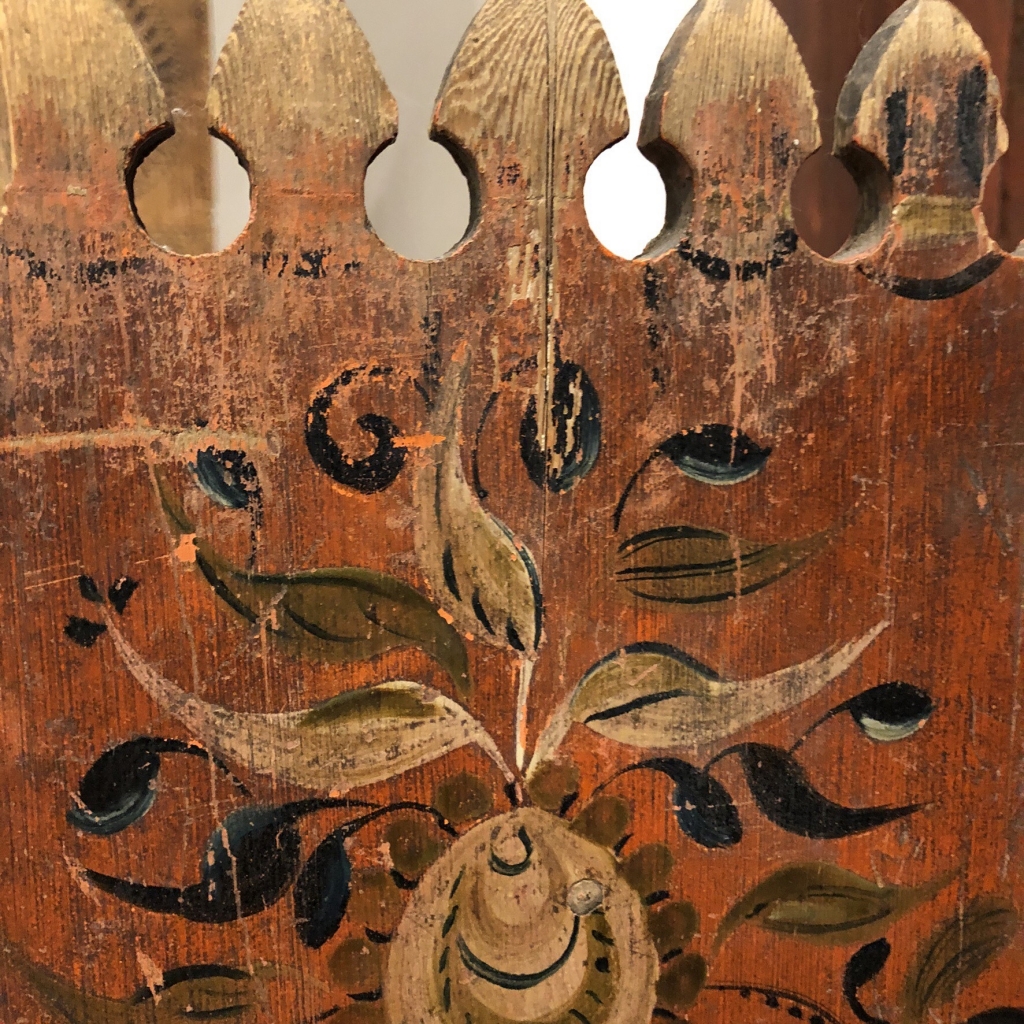
Free-brush (pictorial) paintings became widespread somewhat later — in the second half of the 18th century. These paintings are combined not only by the general technique, but by almost the same motif — different colors were applied with oil paints on an oil background. Paintings of Rakula, Shenkursk, Olonets and Kargopol are pictorial.
The basis of pictorial paintings is a soft, ductile, freely applied brush stroke. The harmony of the color scheme is enhanced by a bright colored background, which determines the color of the painting that is common to this area.
One of the reasons for the rapid implementation of paintings into the artistic life of northern peasants was the existing tradition of decorating utensils and various items with sculptural carvings. Some items were decorated with both paintings and carvings. There were not a lot of things that were decorated with carvings, but almost every item was covered in paintings. In areas where there was no carving tradition, painting did not develop either.
Photo credits to: TIC, E. Shelkovnikov
Information was prepared by the staff of the Arkhangelsk Regional Scientific Library named after N.A. Dobrolyubova, more information on the website http://cultnord.ru/
-
14 August 2020Kenozersky National Park in top-15 amazing places in Russia
-
14 August 2020Arkhangelsk region is the place to visit - recommended by Forbes Life
-
14 August 2020Winter wonderland in caves of Pinega
-
09 November 2017Festival of street theaters in Arkhangelsk entered the top 15 cultural events