Официальный информационно–туристский портал Архангельской области
KHOLMOGORY BONE CARVING. LOOK AT THE FLOWER AND IT WILL WARM YOUR HEART
The north is an amazing place. Outwardly it is restrained and concise. But no matter where you look — the depth of expressive forms and characters opens up under a thin layer of sternness. Same with the bone cutters of Lomonosovo village. Outwardly it is absolutely impossible to distinguish an experienced master with works in famous museums and private collections around the world from an ordinary «cottager». And one certainly doesn’t expect that on the porch of a village house here they will easily keep up a conversation about the frescoes of the Sistine Chapel, Proto-Renaissance or composition techniques. However, this is exactly how things are today in the Lomonosovo village of Kholmogory. For four hundred years entire dynasties of master carvers have been living there.
What do «average tourists» associate with modern Kholmogory? Immediate thought is Mikhail Lomonosov and popular places with summer houses. On the second thought they mention a black-and-white cow or fine bone carving. Less often they remember the Kholmogory chests, hemp ropes, a marine school, shipyards and sawmills, Fedot Shubin, the Brunswick family, the siege of the Kholmogory Kremlin by the Polish-Lithuanian army, sea caravans with grain, Ivan III’s embassies to Europe or something else from the almost 900-years history of the main center of the Dvina lands (before the heyday of Arkhangelsk). All in all, there is definitely something to «Google»!
Getting to Kholmogory is quite simple. It takes an hour and a half to get there by car from Arkhangelsk on the excellent M8 highway. Or it can take a little longer — on a less well-groomed road with sections of primer that goes through Novodvinsk and along the shore of the Northern Dvina. However, in the second case, it is necessary to make sure — during ice drift and spring flood one of the bridges may be closed. From Kholmogory you can get to Kurostrov, to the Lomonosovo village. During winter there is an ice river crossing and in the navigation season there is a ferry.
Timing of the ferries is convenient — a visitor has enough time to visit the museum, walk through the village to the Church of Dmitry Solunsky (Church of Saint Demetrius) and leisurely return to the ferry. It is not necessary to bring a car as this route is quite comfortable for walking. The perfect solution is a bicycle! If one gets to Kurostrov on a car they can see quite picturesque surroundings and take one of the evening ferries on the way back. When there are a lot of cars, the ferry makes additional trips, «Don’t worry, we’ll all leave!». This simple route is quite popular among tourists who want to visit the homeland of Mikhail Lomonosov and Kholmogory carved bone.
The Kholmogory training school of bone carving has been known since the 17th century. Having absorbed the Northern Russian traditions, techniques of German, Dutch masters and traditions of the indigenous peoples of the north, a special Kholmogory style finally developed only by the 18th century. First of all, it is openwork, the thinnest through-thread. Fabulous floral ornaments and elegant rocailles are mixed with bold plot images and tinted engraving.
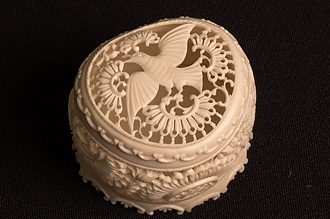
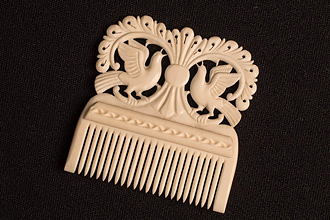
Some of the oldest products are prayer beads, mouthpieces, combs with the finest teeth. All kinds of boxes and caskets modeled after Kholmogory chests, snuffboxes, photo frames, icons, miniatures and portraits were also popular. Later on, they began to make glasses, vases, chess and checkers, furniture cladding, copies of famous sculptures and decorative compositions on a variety of topics.
The best Kholmogory carvers were recruited to work in the Kremlin Armoury and made things for the royal court. Peter I patronized the masters, providing them with samples of western bone-cutting art and Catherine I used Kholmogory carved caskets to store her personal belongings. Bone products were presented as memorable gifts to important persons, the masters were commissioned by monasteries and churches. Decorative vases of Nikolay Vereshchagin which are stored in the Hermitage collection even took part in the first Russian round-the-world trip with the Krusenstern’s expedition as a failed gift to the Emperor of Japan (the embassy was not accepted).
Bone carving was practiced in many villages around Kholmogory. For example, the most significant Russian sculptor of the 18th century, Fedot Shubin, came from a family of bone carvers from Tyuchkovskaya village. However, modern center of the craft is Lomonosovo. A resurgent bone-carving factory is located there, and the museum of the village keeps masters’ works that amaze with its elegance and subtlety. Most recently, a new building of a training school which existed since the beginning of the 20th century was built. The school was named after Nikolay Butorin, an innovator master who widely used the possibilities of graphics in his work, and a wonderful teacher who significantly updated the craft training program.
Dozens of families of bone carvers have been living in Lomonosovo for several generations. Some of its peoples have already become «classics» and some are just beginning to master the craft. Interesting that older generations call 30-40-years-old colleagues «young masters», and those use the same epithet in relation to younger bone carvers. So, how to become a master — how long, what, where and how to learn the craft?
Kholmogory carved bone got a second life at the beginning of the 20th century, when literally the last three masters of the fading craft prepared such impressive works for an exhibition in Moscow that it was immediately decided to open a bone-carving school in Lomonosovo. The first graduate class of this training school (consisting of famous masters and teachers) founded an artel, which then became a bone-carving factory.
Since then, the biographies of many masters of the 20th century are very similar. They learned the basics of the craft in the training school for three years, then worked in a factory and learned from their mentors. Over time, they tried themselves as a teacher, began to do creative work, participate in exhibitions, develop their own style and ideas.
Today experienced craftsmen of that «golden age» work in home workshops. Sometimes even in a house they built themselves with their children who are also young craftsmen. One of such masters of craft is Nikolay Ivanovich Zachinyaev, who came to apply to Lomonosovo from Verkhnyaya Toyma in 1968. «The competition at the school at that time was 2–3 people per place. We started with the simplest tasks such as drawing martens, birds, bunnies... The animal world of the north, all sorts of ornaments are traditional. First you copy old compositions and works. Then you begin to develop your own ornament that is close to you in spirit. And then you come up with an idea and make something. For example, a box or a casket.»
How long does it take before you realize that you are becoming an experienced master? Nikolay Ivanovich answers, «This is the most important question! When I graduated from the bone-carving training school, I thought to myself, „well, now I can do everything!“. I got to the factory, but nothing worked out. Back in the days everyone was given a mentor. You sit next to a good master; he looks at you closely and shows you what to do and how. We’ve all seen each other and watched how others work. You look at how his ornament goes or how interesting his mounting technique turns out and you take it. It’s an experience. Four years have passed like this, yes... Well, of course, there is no limit to perfection. I worked and worked all the time... I watched how others work».
In the 1970s and 1980s during the heyday there were about 90 employees of various levels at the bone-carving factory. Someone was doing the same thing — for example, making tubes or hooks. It was necessary to work quick in order to execute the plan. But the skill was polished to perfection. There was an art council at the factory which consisted of recognized masters. Curators from Moscow Research Institute of Arts and Crafts came periodically. Kholmogory bone carvers were introduced to the works of other schools — for example, the Tobolsk carved bone and works of Chukotka masters. Seminars were held, as a result of which creative tasks were performed.
A major creative work can take several months or even a year. Of course, you have to be distracted from the craft to earn money. But the masters think about the creative task almost constantly, how to make one thing combine with the other, so the product is robust, durable and beautiful. They have to study authentic sources, read books on history and art. The material is quite fragile itself, not to mention the fineness of the thread elements. One wrong move and you’ll have to redo everything. The used tool and technology have hardly changed since the 18th century. Just the originally used fish glue was replaced by PVA adhesive. The most significant innovation was the invention of a drill in the 1950s.
In their work craftsmen, on the one hand, maintain tradition, and on the other — keep up with time. They do what is popular and what has a demand. In Peter’s time, snuffboxes were popular, later — combs and portraits. After Gagarin’s flight they began to make products on a space theme. In the 1990s there was a demand for imposing and large things. Even now sometimes there are offers to make an oil rig mockup, a Harley Davidson motorcycle or Master Yoda, a character from the Star Wars movie, out of bone. Whether to agree or not is up to the master. Most experienced craftsmen are more interested in working within the tradition. But one also needs to make money. Therefore, whether the craft will live or not and how will it change also depends on us, customers.
«So why did the bone-carving industry was preserved in Lomonosovo?» — this question was asked by Galina Dmitrievna Donicheva, who taught drawing, composition and sculpture at the training school for more than 30 years. Once someone suggested, «So they don’t run away from the island!». Perhaps three years of study seem such a long time for young people but for experienced craftsmen in Lomonosovo the most important thing is a special atmosphere. «There must be some kind of aura here... Many people leave and then come back. A person needs silence», says Galina Dmitrievna.
Now the number of applicants to the training school is slowly increasing. Experienced craftsmen are still working in the village. Young people are still «spying» on the work of mentors with a strive to reach a higher creative level through the «routine» of samples. This is how a training school becomes the School, «handicrafts» become Masterpieces, and craft becomes Art! Magic of the place and the living lace of the Kholmogory carved bone can only be revealed with attentiveness and sensitivity. No wonder a hero of one of the «cosmic» works of Nikolai Dmitrievich Butorin says, «Look at a flower and it will warm your heart!».
Photo credits to: Photo - works of various masters from the collection of the Historical and Memorial Museum of M.V. Lomonosov
-
14 August 2020Kenozersky National Park in top-15 amazing places in Russia
-
14 August 2020Arkhangelsk region is the place to visit - recommended by Forbes Life
-
14 August 2020Winter wonderland in caves of Pinega
-
09 November 2017Festival of street theaters in Arkhangelsk entered the top 15 cultural events