
TETERA
On the feast of the solar equinox, when the day alters the night and the sun begins to shine brighter, the housewives cooked «larks» and «grouses» from dough, that special cookie «teterki» in the form of a circle with three circles around it curled around.
Teterki are made of dough rolled (or, as they say in Kargopolye — twisted) into bundles and spread — «curled» — in the circle in the form of waves or loops, spirals, lattices, circles, plants, figures of birds, or even animals.

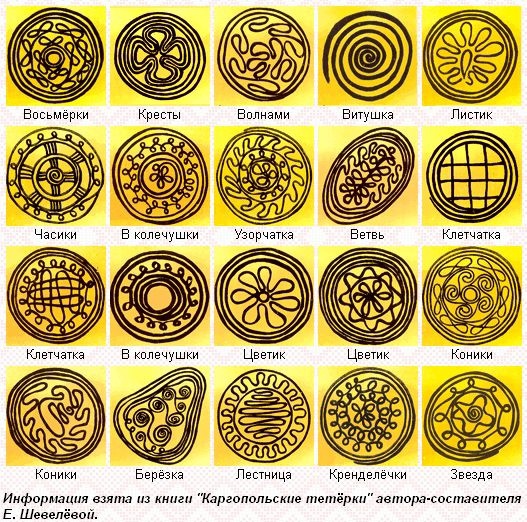
There are a lot of curls and whorls on «teterki». The spiral rolled up in several turns was considered to be one of the oldest symbols denoting the universe visible to people, in the center of which is the throne of the Almighty. The craftswomen used symbols to express their concepts of the world. A straight horizontal line meant land, a wavy horizontal line meant water, a vertical line was rain. Fire and the sun were represented by a cross. Rye teterki could be stored for up to a year.
Besides the important dates, teterki are also included in the ancestral rituals because they are baked on the 40th day after the wedding. «There was a standard amount — 100 teterki», they were baked by a whole family, with the help of neighbors and even the young woman herself was allowed to help in her family’s house for these days. They were carried to newlyweds by a mother-in-law, other relatives came as well. Among these teterki there were special «personal» ones for the son-in-law which had linseed or hemp seed put in them. Then every year the wedding anniversary was celebrated by mother-in-law’s teterki and guest visits (although on a much smaller scale).
Children with teterki ran to hillocks with it to call out the spring. They climbed higher, stretched their teterki to the sun and called for it with ringing voices: «High sun, show yourself! High sun, dress up.»
Nowadays, the tradition of baking teterki for a certain day has been preserved in the villages of the Kargopol district.
Photo credits to: A. Zakharchuk, N. Kozlova
Photos and materials from the book "Kargopol Teki" by E. Sheveleva
-
14 August 2020Kenozersky National Park in top-15 amazing places in Russia
-
14 August 2020Arkhangelsk region is the place to visit - recommended by Forbes Life
-
14 August 2020Winter wonderland in caves of Pinega
-
09 November 2017Festival of street theaters in Arkhangelsk entered the top 15 cultural events